Bioclimatic Pergola vs Awning: Technical Comparison for Specifiers.
Both systems shade a terrace. That is the only point bioclimatic pergola and awning share. In rain protection, service life, wind behaviour, planning law, and whole-life cost they differ substantially
Both systems shade a terrace. That is the only point bioclimatic pergola and awning share. In rain protection, service life, wind behaviour, planning law, and whole-life cost they differ substantially. This comparison sets out the technical differences without marketing.
---
What a bioclimatic pergola is
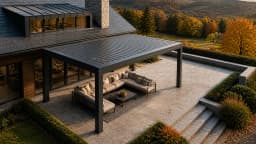
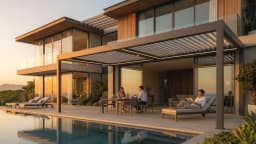
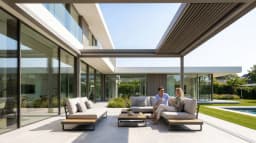
A bioclimatic pergola is a freestanding or wall-mounted aluminium structure with adjustable louvres as its roof. The louvres rotate — motorised or manually — between 0° (fully closed, weathertight) and 90° (fully open, maximum airflow). The system is permanently installed, fixed to foundations, and designed for year-round use.
Core characteristics: 6063-T5 extruded aluminium frame, powder coated; aluminium louvres, 0–115° rotation; rainwater discharged through integrated drainage in hollow posts; EN 1991-1-4 structural calculation required; design life 20–30 years.
---
What an awning is
An awning is a textile shading system attached to a building wall or freestanding frame. The fabric extends and retracts by motor or hand crank. It shades — in rain and strong wind it must be retracted.
Core characteristics: aluminium or steel frame; woven acrylic or polyester fabric; not waterproof when extended (water passes through or pools); wind-sensitive — retraction recommended above 40–60 km/h; fabric replacement every 8–15 years; lower capital cost, higher lifecycle cost.
---
Direct comparison: 7 technical criteria
1. Rain protection Pergola (louvres closed): fully weathertight; water discharged through posts. Awning: not weathertight; water passes through fabric pores or forms a pool that may collapse.
2. Wind behaviour Pergola: designed for EN 1991-1-4 wind loads (zones 1–3 as standard). Awning: retraction required above approximately 60 km/h; structural failure risk if not retracted in time.
3. Temperature control Pergola: adjustable louvres control solar gain and air movement continuously. Awning: binary function (extended / retracted); no airflow management.
4. Year-round usability Pergola: rated for −20°C to +60°C; usable in all seasons. Awning: winter storage or cover required; no snow load rating.
5. Service life and maintenance Pergola: 20–30 year design life; annual cleaning, no structural component replacement. Awning: 8–15 year fabric life; replacement costs €300–800 depending on size.
6. Planning and building consent Pergola: consent-free under approximately 30 m² in most European jurisdictions, but structural calculation still required; above 30 m² building consent needed. Awning: consent-free in almost all cases, not classified as a building structure.
7. Capital cost Pergola: from approximately €4,000 (manual, 3×3 m) to €25,000 (motorised, 4×6 m, with accessories). Awning: from approximately €800 (basic) to €6,000 (motorised cassette with wind sensor).
---
20-year cost comparison (4×3 m, commercial terrace)
| Item | Pergola | Awning | |---|---|---| | Capital cost | €8,500 | €3,200 | | Fabric replacement (×2) | — | €1,400 | | Maintenance / cleaning | €800 | €600 | | Weather damage (estimate) | €200 | €600 | | 20-year total | €9,500 | €5,800 |
The cost difference over 20 years is approximately €3,700 in favour of the awning — without accounting for the operational constraints (no rain, no wind use). In commercial applications (hospitality), those constraints carry direct revenue implications.
---
When to specify each system
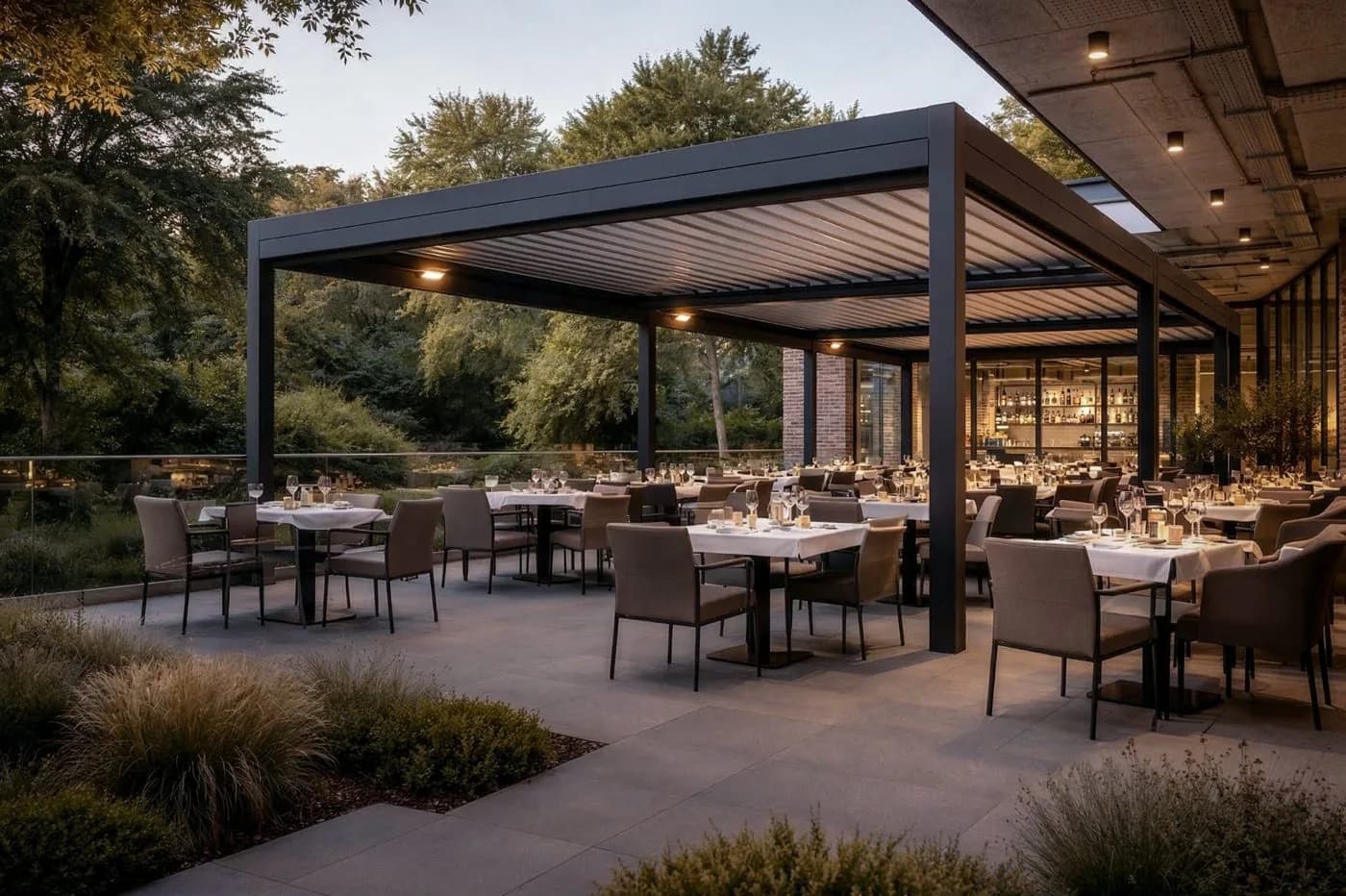
Pergola recommended when: - Year-round use is required (hospitality, hotels, residential terraces with high usage intensity) - Rain protection without user action is needed - Larger spans planned (above 20 m²) - High-value property; visual integration with architecture is important - Combination with heaters, LED, side screens to create an enclosed outdoor room
Awning recommended when: - Budget below €3,000 - Seasonal summer shading only required - No permanent intervention to facade or floor is possible - Rented property without consent options
---
*LuxaShade pergola systems by PONARC: luxashade.com*
PONARC project note
For Bioclimatic Pergola vs Awning: Technical Comparison for Specifiers, the useful specification route is to connect the idea to the real opening, substrate, exposure and intended use. PONARC treats the page as a decision aid: which system family fits, what must be checked, and which assumptions should stay project-specific rather than generic.
Next step
Send the relevant dimensions, photos of the installation area, location context, preferred finish and use case. PONARC can then map the request to the correct product family, technical checks and quotation path without adding unsupported performance claims.
PONARC PROJECT NOTE
How to use this article in a real specification
Treat the article as a planning filter, then confirm dimensions, exposure, fixing surface, operation route and documentation needs with the PONARC team before final quotation.
- Shortlist the matching product family
- Check site assumptions before comparing prices
- Send a brief or drawings for project review
Interested in PONARC products?