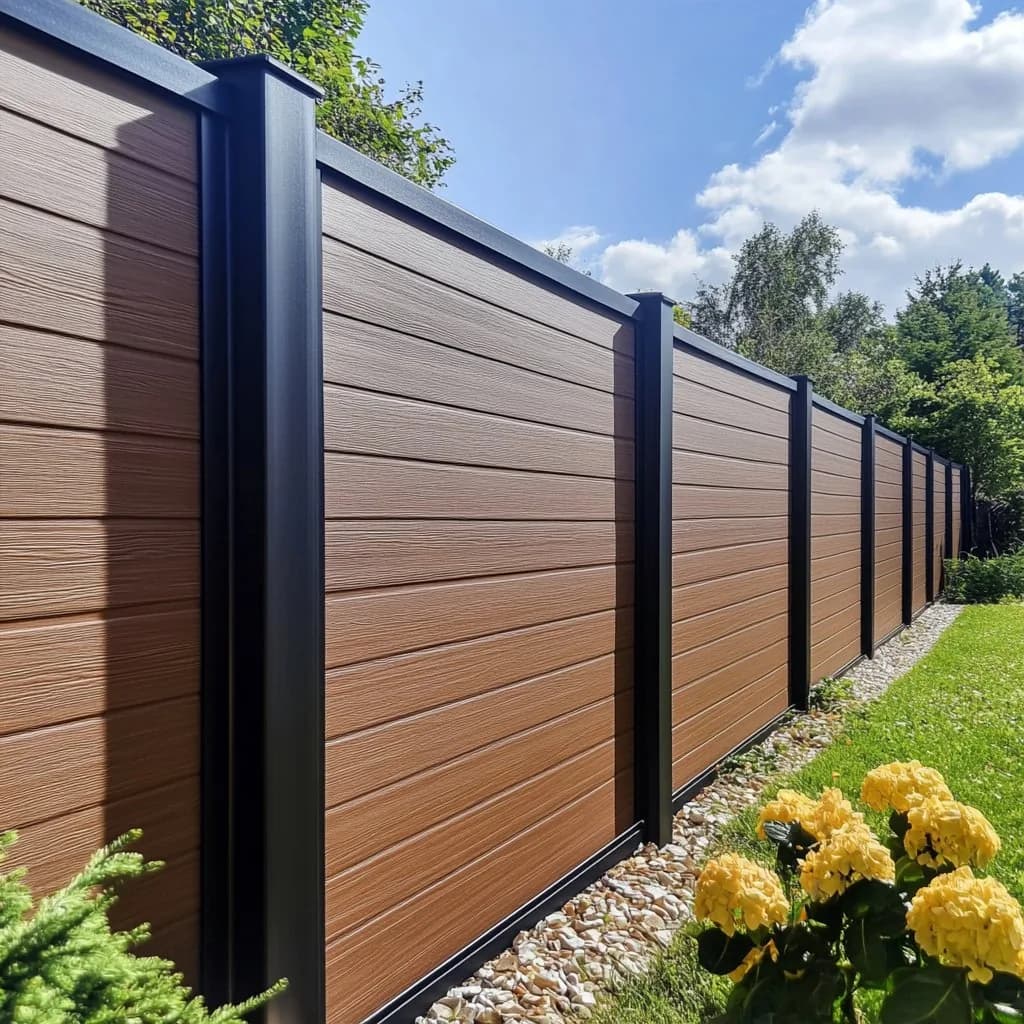
EN 1793-2 acoustic fence guide: how transmission classes work + when 12–18 dB is realistic.
What EN 1793-2 actually measures, why insertion loss is bounded by R_w − 5 dB, and a realistic dB(A) range for residential, arterial and highway-side fences.
Specifying a fence for noise reduction starts with one number that gets quoted everywhere and understood almost nowhere: insertion loss in dB(A). This guide explains what EN 1793-2 measures, why a 25 dB-rated panel rarely delivers 25 dB on site, and what reduction is realistic for typical residential, arterial and highway scenarios.
What EN 1793-2 actually measures
EN 1793-2 — the European standard for noise-reducing devices on roads — classifies the sound transmission through a barrier panel. It runs the panel through a reverberation-chamber test (similar to ISO 10140 for building elements), measures how much airborne sound passes through versus reflects back, and assigns a single-number weighted index R_w in decibels.
A panel rated R_w 32 dB blocks 32 dB of sound when the *only* path between source and receiver is straight through the material. In real installations, that path almost never dominates.
Why insertion loss is bounded by R_w − 5 dB
The acoustic energy reaching a listener behind a fence travels via two paths:
1. Transmission — straight through the panel material. 2. Diffraction — bending over the top edge.
Diffraction is governed by Maekawa's 1968 thin-barrier model: the longer the detour around the top edge versus the direct line of sight, the more attenuation. For a typical 1.8 m fence with the source 8 m away and the listener 4 m behind, the diffracted-path attenuation is around 10–12 dB.
If the panel transmission is much higher than the diffraction loss (e.g. R_w 32 dB, diffraction 12 dB), almost all the energy reaches the listener over the top — the panel's high R_w doesn't help, because the dominant path bypasses it. The system insertion loss tracks the diffraction figure.
If the panel transmission is much lower than the diffraction loss (e.g. R_w 8 dB louvre), the through-panel path dominates and insertion loss is roughly limited by R_w.
The flanking guidance in EN 1793-2 effectively caps insertion loss at R_w − 5 dB — a 5 dB margin to account for edge leakage, panel joints and ground reflection. This is the ceiling our acoustic calculator uses.
Realistic dB(A) reduction by scenario
Field data from European municipal road-noise studies converges on these ranges:
| Scenario | Source level | Fence | Typical IL | |---|---|---|---| | Quiet residential street, 30 km h⁻¹ | 55 dB(A) | 1.8 m slat, half-packed | 6–9 dB | | Busy arterial, bus route, 50 km h⁻¹ | 65 dB(A) | 2.0 m continuous slats | 9–13 dB | | Highway-side, 100 km h⁻¹ | 75 dB(A) | 2.4 m laminated glass | 14–18 dB |
A 10 dB drop is perceived as roughly halving loudness; 20 dB as a quarter. For most road-side residential properties, an honest answer is "expect halving the perceived loudness, not silence."
Slat density vs solid panel — geometry trade-offs
Three common fence build-ups, ranked by acoustic performance:
- Solid laminated glass (10–12 mm + PVB) — R_w 32–36 dB. The transmission ceiling stops being the limiting factor; insertion loss tracks diffraction (roughly 12–18 dB at typical residential geometries). Visual: full transparency, premium feel. - Continuous-slat aluminium with no gap — R_w 26–30 dB. Same transmission-dominated regime as glass for typical heights. Visual: solid privacy line, modern. - Half-packed slat (35–50 % open) — R_w 8–12 dB. Now transmission becomes the limit: even tall fences only deliver 7–10 dB. Choose this geometry for visual airiness, not for noise.
A common specifier mistake is requesting "the highest R_w panel" when the diffraction path is the actual bottleneck. The right move on a 1.8 m residential fence is usually to pick a continuous-slat or laminated-glass panel and increase fence height by 200 mm — the diffraction detour grows non-linearly with height and pays back faster than chasing R_w.
Specifying for tender — what to write in the brief
Three lines that give your structural engineer + acoustic consultant enough to size the fence:
1. Insertion loss target at the receiver position, in dB(A): "≥ 10 dB(A) at 4 m behind a 2.0 m fence, source line at 6 m, receiver ear height 1.5 m." 2. Panel R_w class per EN 1793-2: "R_w ≥ 28 dB for the panel build-up." Sets the transmission ceiling above the diffraction floor so geometry, not material, becomes the binding constraint. 3. Fall-back clause for ranges where in-situ measurement matters: "If the post-installation measurement at the receiver position differs by more than 3 dB from the calculated value, the supplier will adjust panel build-up at no cost." Protects you from optimistic supplier numbers.
How our acoustic calculator handles this
Our acoustic noise-reduction calculator implements the full Maekawa diffraction model + the EN 1793-2 R_w − 5 dB transmission ceiling per panel build-up. Pick a source (road-urban / arterial / highway / HVAC / pool pump), a panel (slat-half-packed, slat-continuous, WPC, ESG glass, laminated glass), and a 4-parameter geometry (fence height, source distance, receiver distance, ear height). Output: the dB(A) reduction at your listener position plus a perception band ("clearly audible improvement", "≈ halved loudness", etc.).
The calculator's method note links back to this article and to the rest of our acoustic standards reference.
---
*VisioMod fences ship with EN 1793-2 panel test data on request — contact our engineering team if you need the certificate for a specifier brief.*
PONARC project note
For EN 1793-2 acoustic fence guide: how transmission classes work + when 12–18 dB is realistic, the useful specification route is to connect the idea to the real opening, substrate, exposure and intended use. PONARC treats the page as a decision aid: which system family fits, what must be checked, and which assumptions should stay project-specific rather than generic.
Next step
Send the relevant dimensions, photos of the installation area, location context, preferred finish and use case. PONARC can then map the request to the correct product family, technical checks and quotation path without adding unsupported performance claims.
PONARC PROJECT NOTE
How to use this article in a real specification
Treat the article as a planning filter, then confirm dimensions, exposure, fixing surface, operation route and documentation needs with the PONARC team before final quotation.
- Shortlist the matching product family
- Check site assumptions before comparing prices
- Send a brief or drawings for project review
Interested in PONARC products?