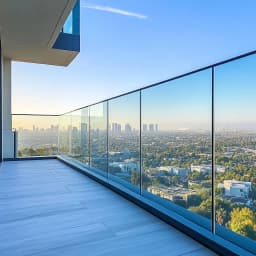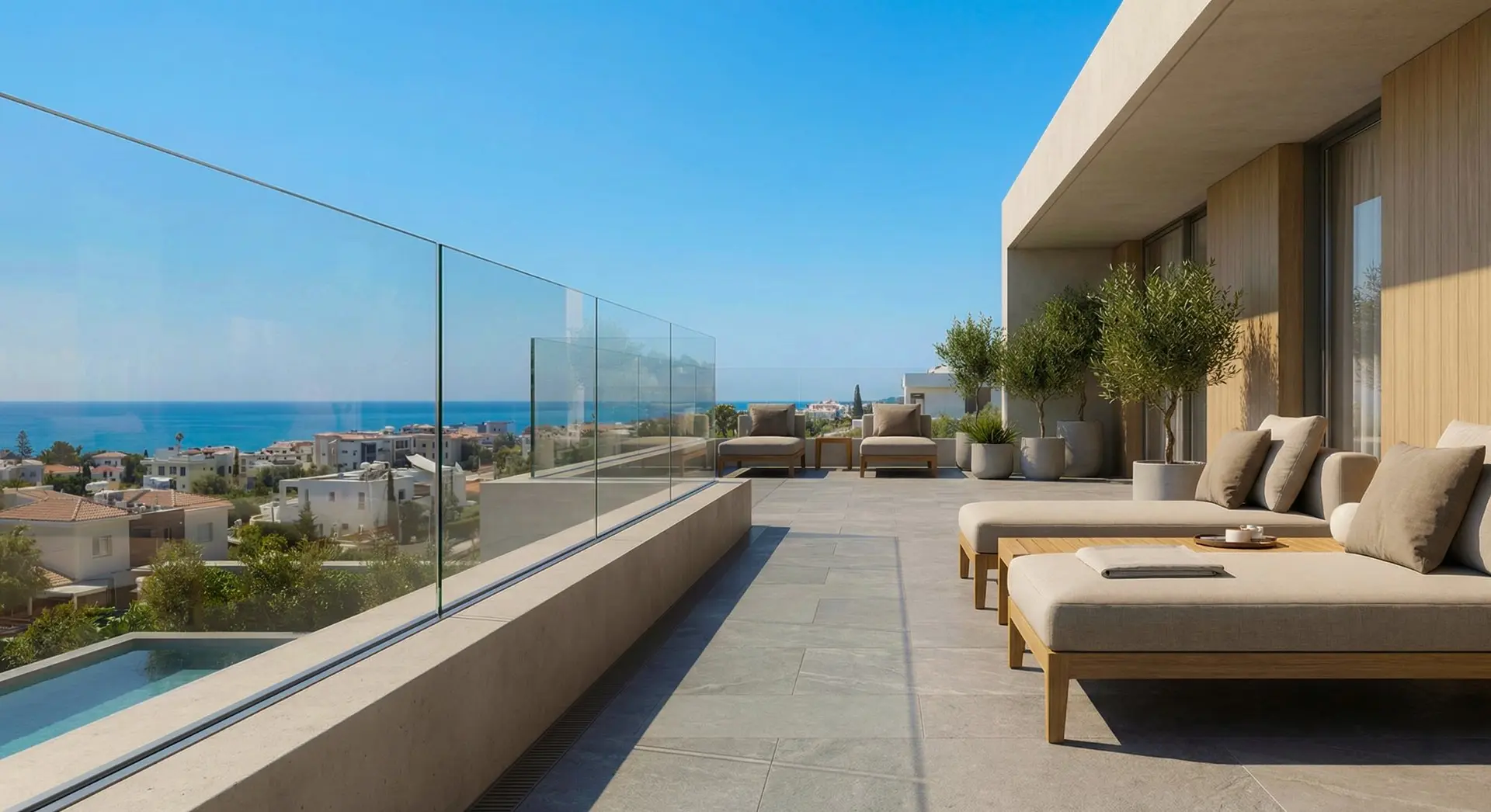
Glass railing vs stainless cable railing — code, cost, and TCO compared.
A specifier-grade comparison of frameless glass railings (VSG/EN 14179/DIN 18008-4) and tensioned stainless cable balustrades. Code certainty, wind/snow behaviour, maintenance regime and 10-year TCO.
Two systems compete for the same brief — terrace, balcony or roof-level fall protection where the architect wants minimum visual obstruction. Frameless glass (toughened laminated, EN 14179 ESG-H + EN 14449 VSG, DIN 18008-4 categorised) and tensioned stainless cable (316L stainless wire, terminal-fitted balusters). They look similar in renderings; they perform very differently in service. Here's the side-by-side, focused on the four decision factors specifiers actually use.
1. Code certainty
Frameless glass sits in a fully mapped regulatory framework. EN 14179 + EN 14449 define the product. DIN 18008-4 (in DACH), BS EN 1991-1-1 NA (in UK), NF DTU 39 (in FR) define the *application* — exactly which glass-build is permitted in what configuration, edge support, and load class. A specifier writes "DIN 18008-4 Kategorie A, 10.10.4 mm VSG aus 2× ESG-H" and every component is determined.
Cable balustrades are not formally categorised in DIN 18008 (it's a glass standard) and only loosely covered by EN 13374 (temporary railings during construction). For permanent fall-protection cable balustrades, German Bauamten typically require a project-specific *abZ* (allgemeine bauaufsichtliche Zulassung) demonstrating cable tension, end-fitting pull-out values, and post-spacing per the live load. Each project re-litigates the spec — adds 3–4 weeks and ~€1500–3000 in engineering fees.
For a tender that needs to ship without permit-route ambiguity, glass wins on day one.
2. Wind + snow behaviour
Glass is a rigid panel. Wind pressure deflects it elastically (~5–8 mm at qb 0.5 kN/m² for a 1.1 m × 1.5 m panel) and recovers fully. Snow accumulation on a glass-edge balustrade is irrelevant — vertical surface, no shelf. The DIN 18008-4 calc covers the wind envelope per EN 1991-1-4 NA and that's the design driver.
Cable is a tensioned wire. Wind pressure acts on the *people* leaning on it, not on the wire — but the wire's ability to resist horizontal load depends entirely on its pre-tension (typically 1500–2500 N per cable). Pre-tension drifts: stainless 316L stretches by ~0.1–0.3 % over 5 years, more in salt-spray environments. A loose cable balustrade is a fall-protection failure. Annual tension audit + retensioning is required for code-compliant operation. Snow doesn't accumulate on cable, but ice can — adding ~10–15 % to the apparent diameter and changing the visual + drag profile.
3. Maintenance regime + TCO
Glass: - Cleaning: 2–4× per year, soap + water, ~5 minutes per panel. - Lifecycle: 25+ year service life. ESG-H means spontaneous nickel-sulfide breakage is screened out at the factory. - Replacement: the laminated PVB interlayer holds shards together if a panel does break — the failed panel is replaced as a whole unit, no scaffold reinstatement. - 10-year TCO (per metre of railing): ~€350–450 (initial €280–380 + cleaning ~€10/year × 10 + 0–1 panel replacement reserve).
Cable: - Annual tension audit: ~€80–120 per audit (specialist + test gauge). - Retensioning every 12–24 months: ~€20–40 per cable, ~€150–250 per audit visit. - End-fitting inspection: every 5 years, replace fittings showing pitting (especially in coastal projects). - 10-year TCO (per metre): ~€280–380 (initial €120–180 + €150–200 in audit/retensioning + replacement reserve €30–50).
Cable looks cheaper on day one (~€60–200 less per metre), but the audit + retensioning regime narrows the gap to ~€20–80/m advantage by year 10. In hospitality contexts (where audit downtime + tradesman visibility on-site is a UX cost), the gap closes further.
4. Aesthetic + visual obstruction
This is where cable wins on perception:
- Glass has a visible reflection, ~8–10 % light blocking in clear configurations, more in laminated / heat-soaked. The glass edge is visible at angle. - Cable is ~3 mm wires at 100–125 mm spacing — visually nearly invisible against most backgrounds.
But two specifier counter-considerations:
- Children (under 4 yrs) can in some cases use cables as a foothold to climb over a balustrade — non-trivial concern in residential / hotel + family-resort contexts. Cable balustrades are not recommended where children frequent the space without supervision. - Glass bird-strike: in nature-adjacent installations, glass can cause bird collisions. Decals or fritted glass mitigates this; cable doesn't have the issue.
When to pick which
| Use case | Glass | Cable | |---|---|---| | DACH B2B specifier (DIN 18008 needed) | ✅ | abZ project-by-project | | Coastal hospitality (≤ 5 km from coast) | ✅ + Seaside coating | ⚠ + corrosion audit | | Family residential / hotel | ✅ | ⚠ child-climb risk | | Listed building / heritage retrofit | ⚠ visual change | ✅ minimal visual impact | | Net-zero / lifecycle certification | ✅ closed-loop recycled glass | ⚠ stainless lifecycle higher | | Bird-strike-sensitive (forest, riverbank) | ⚠ requires fritting | ✅ | | Lowest day-one cost | — | ✅ | | Lowest 10-year TCO | ✅ marginally | — |
Connecting back to our products + standards hub
The PONARC group glass railing range — VisioMod Cristallo frameless toughened, channel-mounted or post-mounted variants — is fully DIN 18008-4 categorised and EN 14179 / EN 14449 certified. Each spec sheet lists the DIN 18008 category mapping (A, B or C) and the glass-build combination. Our engineering team supports the project-specific calc against DIN EN 1991-1-4 NA for any country.
For the regulatory deep-dive, see the DIN 18008 article, the EN 12150 vs EN 14179 article, and the glass section of the standards hub. For wind-load context, the wind & snow specifier calculator.
---
*Comparing glass + cable for a specific project? Contact our engineering team — we provide a side-by-side compliance + TCO sheet within two working days.*
PONARC project note
For Glass railing vs stainless cable railing — code, cost, and TCO compared, the useful specification route is to connect the idea to the real opening, substrate, exposure and intended use. PONARC treats the page as a decision aid: which system family fits, what must be checked, and which assumptions should stay project-specific rather than generic.
Next step
Send the relevant dimensions, photos of the installation area, location context, preferred finish and use case. PONARC can then map the request to the correct product family, technical checks and quotation path without adding unsupported performance claims.
PONARC PROJECT NOTE
How to use this article in a real specification
Treat the article as a planning filter, then confirm dimensions, exposure, fixing surface, operation route and documentation needs with the PONARC team before final quotation.
- Shortlist the matching product family
- Check site assumptions before comparing prices
- Send a brief or drawings for project review
Interested in PONARC products?