WPC vs Aluminium: Which Is Better for Outdoor Structures?.
A direct, spec-by-spec comparison of WPC (wood-plastic composite) and aluminium for pergolas, fences, carports and decking — durability, cost, maintenance and which one wins.
Short answer: for structural outdoor systems (pergolas, carports, fences) aluminium wins by every objective measure — durability, lifespan, fire safety, maintenance, recyclability. WPC competes only on initial appearance and unit cost, and only in non-structural applications.
This is the spec-sheet view, not the showroom pitch.
What is WPC?
WPC stands for Wood-Plastic Composite — typically 50–70% wood flour bound with a polymer (HDPE or PVC). Sold as decking boards, fence panels and cladding. Looks wood-like, behaves part-wood / part-plastic.
What is structural aluminium?
For outdoor systems, the relevant alloy is 6063-T5 — heat-treated aluminium with magnesium and silicon. Standard for pergolas, carports, glass railings, brise-soleil. Powder-coated to QUALICOAT Class 2 or QUALICOAT Class 2 powder coat spec for outdoor longevity.
Side-by-side spec comparison
| Property | WPC | Aluminium 6063-T5 | |---|---|---| | Service life | 10–20 years | 25–50+ years | | Fade resistance (UV) | Moderate — visible after 5–8 years | High — QUALICOAT Class 2 = 15+ years no visible fade | | Fire rating (EN 13501-1) | D-s2,d0 typical | A1 (non-combustible) | | Wind/snow load | Limited — most WPC is clad over a steel/alu core | EN 1991 project documentation route | | Water absorption | 0.7–2% (causes swelling, mould risk) | 0% | | Frost resistance | Boards split below −20°C in unprotected installs | Unaffected by freeze-thaw | | Maintenance | Annual cleaning, periodic re-oiling/staining | Wash twice yearly, no recoating | | Recyclability | 0–30% | 98% recyclable, no quality loss | | Weight | 0.85–1.20 kg/m | 0.30–0.55 kg/m for structural profiles | | Initial cost (decking €/m²) | €40–80 | €110–180 (with substructure) | | Lifetime cost (€/m²/year) | €4–8 | €3–7 | | Insect / rodent damage | Possible (wood content) | None |
When does WPC make sense?
- Decking surface where you want a wood-like aesthetic without the maintenance of real wood. - Privacy fence panels for non-windy garden sites where structural wind load is below 0.5 kN/m². - Cladding over an existing structural frame where you only need a finish layer.
When does aluminium win clearly?
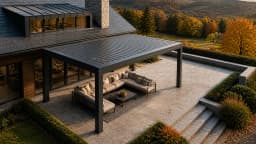
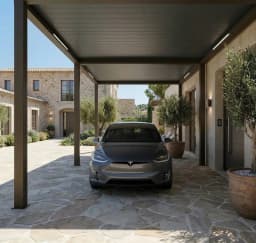
- Pergolas — bioclimatic, retractable or fixed-louvre. WPC pergolas don't exist as load-bearing structures because WPC creep under sustained load is severe. - Carports — snow load + UV exposure. WPC carports fail at the column-to-beam joint within 5–10 years. - Glass railings / balconies — no WPC product meets EN 1991-1-1 imposed-load requirements (≥1.0 kN/m horizontal). - Brise-soleil and façade louvres — WPC bows under solar heat (peak panel temperatures of 70–85°C cause 8–15 mm/m thermal expansion, vs aluminium's 0.024 mm/m/°C controllable expansion). - Coastal installations — WPC swells in salt-air humidity; aluminium with marine-grade powder coat is unaffected.
Cost truth
WPC's "lower price" headline is real on the showroom floor. But aluminium structures last 2–3× longer, WPC requires periodic sealing or replacement of warped boards, and WPC can't be re-coated to a different colour cleanly. Lifetime cost (initial + maintenance + replacement) lands within €1/m²/year of each other, with aluminium edging ahead at the 25-year mark.
Fire and code
In the EU, EN 13501-1 fire classification matters for any outdoor structure attached to or near a building. Aluminium is A1 (non-combustible). WPC ranges D-s2,d0 to E — combustible with smoke. For terraces of multi-residential buildings, hospitality venues, or anywhere within 3m of a façade opening, fire classification is often the deciding code constraint.
Recyclability
End-of-life recovery: aluminium is 98% closed-loop recyclable, infinite times, with 5% of the original embodied energy. WPC is 0–30% material recovery in practice. Most ends up in landfill due to mixed plastic+fibre content. For corporate ESG reporting and EU Taxonomy compliance, aluminium has the documented circular-economy story.
FAQ
Is WPC stronger than aluminium? No. Aluminium 6063-T5 has a tensile strength of ~185 MPa. WPC ranges 15–35 MPa depending on composition. For load-bearing applications the difference is decisive.
Does aluminium get hot in the sun? Powder-coated aluminium reaches 50–65°C peak in direct summer sun. WPC reaches 70–85°C due to its dark composite mass.
Which has lower thermal expansion? Aluminium expands 0.024 mm/m/°C. WPC expands 0.035–0.060 mm/m/°C — meaningfully more.
Will aluminium corrode? Aluminium oxidises naturally to form a protective oxide layer. With QUALICOAT Class 2 powder coat + marine-grade pretratament, it's effectively unaffected for 25+ years even at coast.
Is WPC better for the environment? Marketing claim, not reality. Recycled-content aluminium has lower embodied carbon over 25 years than WPC (which is plastic + harvested wood + non-recyclable bonding chemistry).
Conclusion
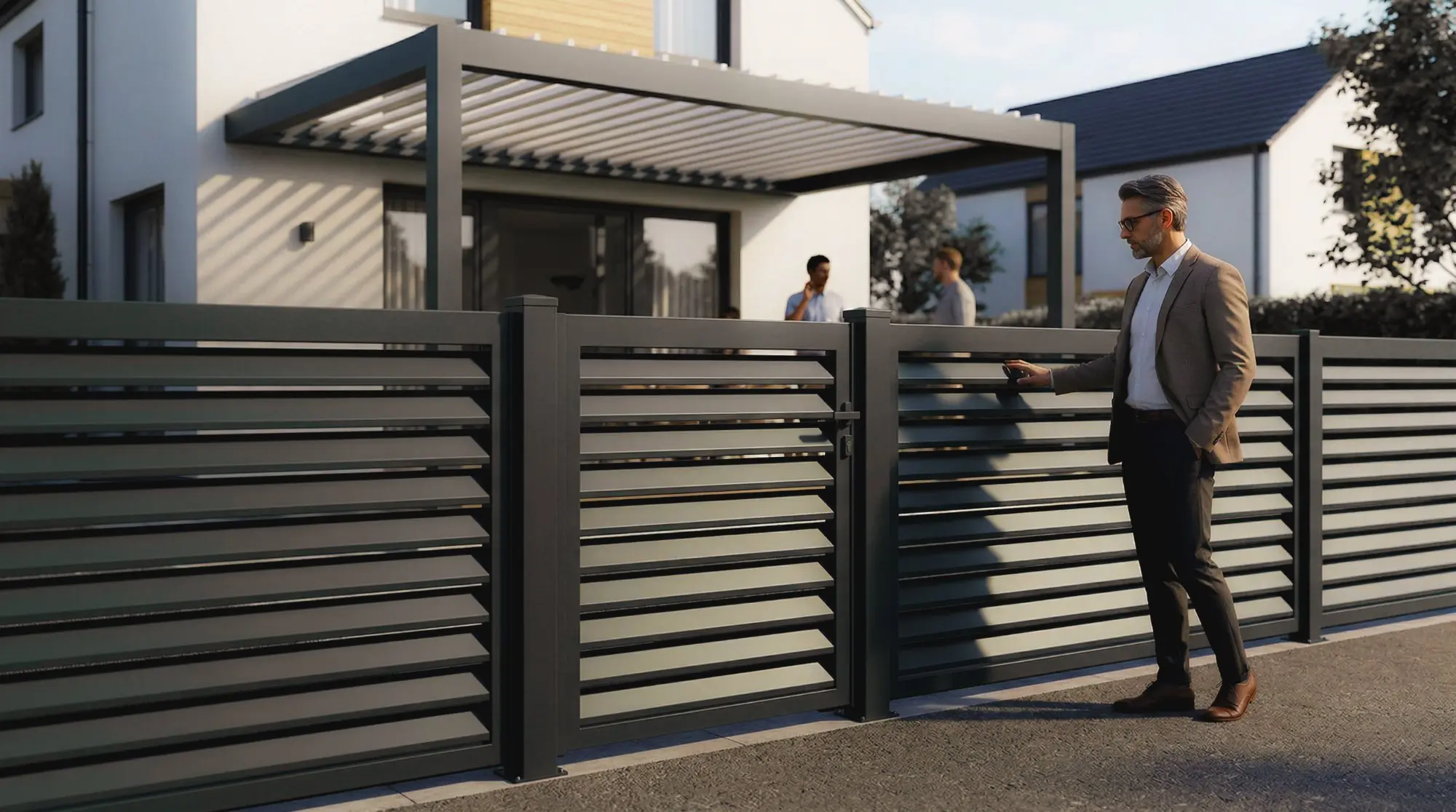
For anything that needs to carry a load, span a distance, or last 25+ years, aluminium is the right material. WPC has a niche as a finish layer where the structural job has already been done by something else. For the comparison most homeowners actually face — *aluminium fence vs WPC fence* — both work for residential applications, but aluminium delivers 2–3× the service life at roughly equivalent lifetime cost.
PONARC supplies aluminium structural systems to QUALICOAT Class 2 spec for pergolas, glass railings, brise-soleil and fence systems across Europe.
PONARC project note
For WPC vs Aluminium: Which Is Better for Outdoor Structures?, the useful specification route is to connect the idea to the real opening, substrate, exposure and intended use. PONARC treats the page as a decision aid: which system family fits, what must be checked, and which assumptions should stay project-specific rather than generic.
Next step
Send the relevant dimensions, photos of the installation area, location context, preferred finish and use case. PONARC can then map the request to the correct product family, technical checks and quotation path without adding unsupported performance claims.
PONARC PROJECT NOTE
How to use this article in a real specification
Treat the article as a planning filter, then confirm dimensions, exposure, fixing surface, operation route and documentation needs with the PONARC team before final quotation.
- Shortlist the matching product family
- Check site assumptions before comparing prices
- Send a brief or drawings for project review
Interested in PONARC products?