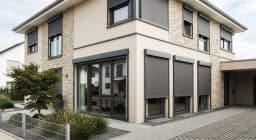
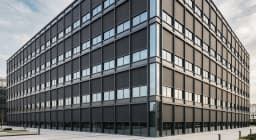
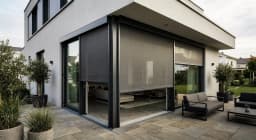
Brise Soleil Guide for Architects: Aluminium Facade Shading and Solar Control.
Specify fixed or adjustable aluminium brise soleil systems for facades: reduce solar heat gain, manage glare, support ventilation and meet EN 1991 wind-load requirements.
A brise soleil (literally "sun breaker" in French) is a fixed or adjustable system of aluminium louvres, screens, or fins attached to a building's facade to control solar radiation and reduce unwanted heat gain. This guide explains how they work and when to specify them.
What is a Brise Soleil?
A brise soleil is an architectural element — either fixed (permanently angled) or movable (adjustable via motorisation or manual control) — that intercepts direct sunlight before it reaches windows or building surfaces.
The most common designs are: - Fixed angled louvres: Aluminium fins at a permanent angle (typically 30–60°) that block high summer sun while allowing lower winter sun through. - [Sliding brise soleil](/en/products/brise-soleil/sliding): Motorised horizontal or vertical panels that adjust to sun position throughout the day. - [Folding brise soleil](/en/products/brise-soleil/folding): Articulated panels that fold in/out to adapt to changing sun angles seasonally. - Perforated metal screens: Solid-looking facades that allow views and ventilation while blocking direct radiation.
Why Solar Heat Gain Matters
In commercial and residential buildings, uncontrolled solar radiation accounts for 20–40% of cooling loads in summer. Even with high-performance triple-glazed windows, heat transfer through glass remains significant.
A well-designed brise soleil can reduce solar radiation reaching a facade by 60–85%, translating to: - Lower cooling costs: 15–25% reduction in summer air-conditioning load. - Better interior comfort: Reduced glare and thermal inconsistency at work stations. - Extended HVAC lifespan: Smaller peak loads mean less strain on cooling equipment.
How Brise Soleil Systems Work
Solar Angle Blocking: The louvre or screen angle is calculated based on the building's latitude and orientation. In northern Europe (50–55°N), south-facing facades need steeper angles (40–50°) to block summer sun without blocking winter sun entirely.
Facade Ventilation: Unlike solid facades, brise soleil systems allow air circulation behind the louvres. Hot air trapped between the outer louvres and the glass is vented away, preventing heat build-up. This "ventilated facade" principle is critical to DIN 18516 compliance.
Light and Privacy: Perforated or semi-opaque louvres diffuse daylight into the building while preventing external viewing. Occupants see soft, glare-free light; outsiders see a uniform facade.
Structural Integration: Brise soleil are typically mounted on the structural frame, independent of the window system. This allows easy retrofit to existing buildings.
Standard Types
Fixed Louvres - **Pros:** No moving parts, low routine care, lowest cost. - **Cons:** Cannot adapt to seasonal sun angle changes; may block too much winter sun or too little summer sun if poorly designed. - **Best for:** South-facing facades in stable latitudes where one angle works year-round.
Sliding Horizontal Brise Soleil - **Pros:** Motorised adjustment allows seasonal and daily optimization. Aesthetic appeal — clean lines when retracted. - **Cons:** Mechanical complexity, higher cost (€500–€1,500 per m²), motor maintenance. - **Best for:** High-rise office buildings where occupant comfort and energy savings justify the cost.
Folding Brise Soleil - **Pros:** Space-efficient — folds flush against the facade when not needed. Adjustable to multiple angles. - **Cons:** Mechanical linkages prone to jamming in harsh climates; requires regular maintenance. - **Best for:** Secondary facades or shaded areas where part-time shading is adequate.
Technical Standards
DIN 18516 (Ventilated Facades): This German standard defines how ventilated facade systems must perform structurally and thermally. Brise soleil must: - Resist wind loads per EN 1991-1-4 (Eurocode 1). - Provide adequate drainage and ventilation (minimum 2cm gap between louvre and facade). - Support thermal movement without transferring stress to the window frame.
Certification Credits: - EAc2 (Energy Performance): Brise soleil contribute to reduced cooling loads, earning 1–3 points. - IEQc8 (Daylight & Views): Brise soleil that maintain view-out and diffuse daylight earn points.
Design Considerations
Orientation: - South-facing: Needs steep louvre angles (40–60°) to block summer sun; allow winter sun through. - East/West-facing: More challenging — low sun angles in early morning/late afternoon. Often requires vertical fins in addition to horizontal louvres. - North-facing: Rarely needs brise soleil unless the building's latitude or local context creates significant reflection.
Material Durability: - Extruded aluminium: Most common. Lightweight, corrosion-resistant with QUALICOAT Class 2 coating (15+ years durability). - Stainless steel: For coastal environments. Higher cost, superior durability. - Wood with protective finish: Traditional aesthetic; requires 2–3 year refinishing cycle.
Maintenance Access: - Fixed louvres: Access for occasional cleaning (water + soft brush). - Motorised systems: Require annual motor inspection and lubrication. Control electronics need protection from moisture.
Energy Performance (Fc Value)
The Fc value (solar factor) of a brise soleil ranges from 0.10–0.50 depending on louvre density and angle: - Fc 0.10–0.20: Dense louvres, minimal solar transmission — suitable for south-facing facades in warm climates. - Fc 0.30–0.40: Moderate density — balances solar control with daylighting. - Fc 0.40–0.50: Sparse louvres — maximum daylighting, less solar control.
Architects often pair brise soleil with high-performance glass (U-value 0.15 W/m²K or lower) to achieve overall facade Fc values of 0.25–0.35.
Cost and ROI
Fixed louvres: €300–€800 per m² (one-time cost). Motorised sliding systems: €600–€1,500 per m². Folding systems: €400–€1,200 per m².
For a 500 m² south-facing facade: - Fixed louvres: €150,000–€400,000 capex. Annual maintenance: ~€1,000. Energy savings: 15–20% of annual cooling cost (~€8,000–€12,000 for a typical office building). - ROI: 12–20 years in warm climates.
Conclusion
Brise soleil systems are one of the most effective ways to reduce solar heat gain on commercial and high-rise residential facades. By combining structural durability, low maintenance, and significant energy savings, they justify their upfront cost across most European markets.
PONARC project note
For Brise Soleil Guide for Architects: Aluminium Facade Shading and Solar Control, the useful specification route is to connect the idea to the real opening, substrate, exposure and intended use. PONARC treats the page as a decision aid: which system family fits, what must be checked, and which assumptions should stay project-specific rather than generic.
Next step
Send the relevant dimensions, photos of the installation area, location context, preferred finish and use case. PONARC can then map the request to the correct product family, technical checks and quotation path without adding unsupported performance claims.
PONARC PROJECT NOTE
How to use this article in a real specification
Treat the article as a planning filter, then confirm dimensions, exposure, fixing surface, operation route and documentation needs with the PONARC team before final quotation.
- Shortlist the matching product family
- Check site assumptions before comparing prices
- Send a brief or drawings for project review
Related Products
Interested in PONARC products?