Engineering overview
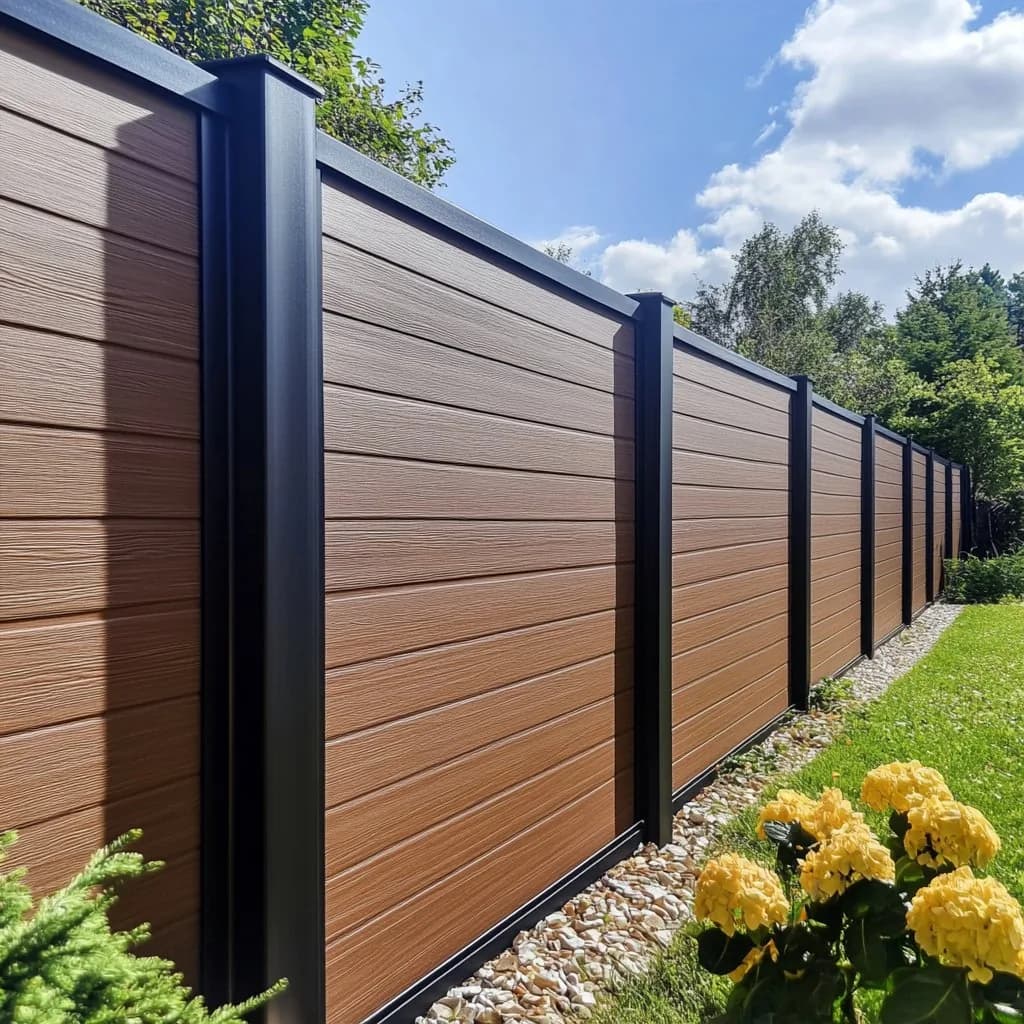
VisioMod Bosco resolves the architect's perennial dilemma between the visual warmth of timber and the operational reality of low-maintenance perimeter systems. The panel is constructed as a true hybrid: a structural aluminium frame in 6063-T5 alloy with 50 × 50 mm sections, infilled with engineered WPC slats composed of 60 % responsibly sourced wood fibre, 30 % HDPE polymer matrix, and 10 % UV stabilisers and performance additives. This composition is deliberate, not arbitrary. Pure timber, however well-specified, surrenders to weathering, demands cyclical staining, and silvers unevenly across orientations. Pure WPC without a structural skeleton sags under thermal load and span pressure, particularly in southern climates where surface temperatures cycle aggressively. Bosco separates the two roles: aluminium carries the load, WPC carries the visual identity. The result is a fence panel that reads as wood at three metres and performs as engineered cladding at ten years.
The specification palette comprises five woodgrain finishes — Teak, Walnut, Oak, Anthracite Wood, and Driftwood — each developed to hold its tonal register through prolonged UV exposure rather than fade toward generic grey. Two slat profiles are offered: Standard at 100 × 25 mm for fine, even rhythm reminiscent of contemporary timber screens, and Grande at 200 × 25 mm for bolder horizontal banding suited to larger architectural masses. Maximum clear span between posts is 2000 mm, with the aluminium frame ensuring the WPC infill remains planar and dimensionally stable across that span. Wind load capacity is rated at 1.0 kN/m² for standard configurations and 1.4 kN/m² for reinforced coastal specifications, qualifying Bosco for exposed suburban and peri-coastal contexts.
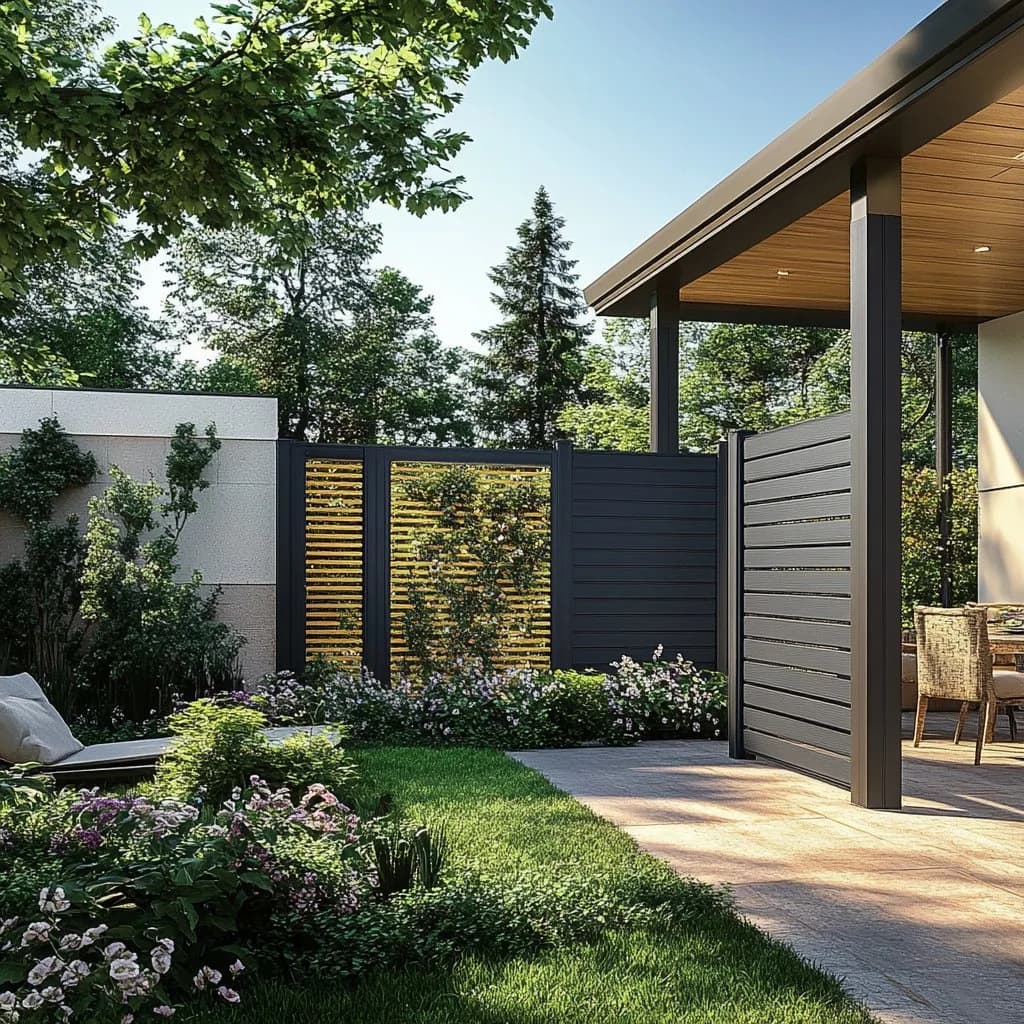
The optional Modulo Light integration elevates Bosco from a boundary element to a landscape lighting component. Vertical LED strips recessed into the aluminium post profiles illuminate the WPC slat faces from the side, producing a warm grazing wash that accentuates the woodgrain texture without hotspot or glare. The system runs at 24 V DC SELV with IP68 emitters and an IP67-rated driver, compliant with EN 60598-1 and EN IEC 62471 photobiological safety classification. Available in 2700 K, 3000 K, and 4000 K with CRI ≥ 90, the LED package integrates with RF, Zigbee, and Matter control protocols, enabling the fence run to participate in the wider residential or landscape lighting scene. At poolside and terrace zones the warm grazing effect — visible in the gallery's golden-hour and evening shots — demonstrates that Bosco does not simply border a garden space; it completes the ambient composition of it.
Maintenance is reduced to a biannual freshwater rinse — no oiling, no staining, no sanding, no annual refinishing cycle. The 10-year colour stability warranty underwrites the woodgrain finish against meaningful UV-driven shift, allowing landscape architects to specify a warm, organic-reading boundary without committing the client to the recurring labour and cost burden of solid timber. Bosco is positioned within the Essentials tier: warmth of timber, discipline of engineered systems, with neither compromise carried forward into the maintenance schedule.
Architectural integrationReading on the facade
Woodgrain pairing strategy follows facade tonality rather than personal preference. Anthracite metal cladding or dark zinc-effect facades pair with Teak Bosco — the warm orange-brown register reads against the cool dark mass and prevents the perimeter from disappearing visually. White render or chalk-toned facades pair with Driftwood Bosco, where the silvered grey register offers contrast without aggression and reads as a considered neutral. Exposed brick or terracotta facades pair with Walnut Bosco, where deep brown undertones harmonise with the masonry palette without repeating it. Anthracite Wood operates as a graphic frame against pale natural stone, and Oak serves as a default warm-neutral for mixed material contexts.
Over a 10-year horizon, Bosco holds its tonal register where solid timber would have silvered to uniform grey and PVC would have chalked. The 10-year colour stability warranty provides the specifier with documentary evidence for the client that finish performance is a guaranteed deliverable rather than a maintenance aspiration.
At view zones — pool edges, terrace overlooks, garden axes — pair Bosco with Cristallo frameless glass panels: Bosco contributes warmth and visual mass to closed boundaries, Cristallo opens the view selectively. The aluminium post profile is dimensionally compatible between series, ensuring a clean junction at the Bosco-to-Cristallo transition without a change in post geometry.
For projects incorporating the Modulo Light LED program, the post section hosts the LED driver and strip within the aluminium extrusion cavity, leaving no surface-mounted hardware visible on the fence face. The 24 V DC SELV system operates within standard residential electrical zone classifications; in most European jurisdictions the low-voltage nature removes the requirement for a licensed electrician for the DC side of the installation, though the 230 V transformer supply must be installed by a qualified person. Specify the luminaire CRI and colour temperature at the same stage as the WPC finish: 2700 K with Walnut or Teak for the warmest evening register; 3000 K with Oak or Driftwood for a crisper, more contemporary night-time reading; 4000 K reserved for commercial or high-security perimeter contexts where task lighting rather than ambience is the priority.
Coordination with the structural engineer is required where Bosco posts are anchored into an existing retaining wall: the anchor specification must comply with ETAG 001 pull-out values for the concrete grade in use, and the post must be confirmed as adequate to resist combined wind load per EN 1991-1-4 and the lateral retained-soil load acting simultaneously at the wall crown. On sites within frost zones, foundation depth must comply with DIN EN 1997 provisions to prevent heave-driven post displacement.
InstallationFoundation & site notes
Foundation requirements for standard Bosco installations are lighter than those for solid-infill systems owing to the reduced wind-catch surface of the slat geometry. Typical specification is a 400–500 mm deep concrete footing at 2000 mm post centres, sized per the local wind exposure class and confirmed against EN 1991-1-4 wind load parameters. For coastal sites where aluminium is exposed to marine atmosphere, specify Qualimarine pre-treatment on the powder-coat preparation in addition to Qualicoat Class 2 certification on the topcoat.
WPC slats require an engineered expansion gap at slat-end terminations to accommodate thermal movement across the diurnal and seasonal cycle — typically 3–5 mm per linear metre of slat run. The factory-engineered frame-to-WPC engagement clip system handles this automatically; site-cut slat adjustments must preserve the gap. Never butt-join slat ends tightly into post channels — thermal expansion will cause bowing within the first summer cycle.
For retaining-wall crown installations (as shown in the gallery's lavender-border dining terrace image): anchor plates must be specified to ETAG 001 pull-out requirements for the concrete grade of the retaining wall. Do not use standard ground-spike anchors in retained-soil situations; the combined wind and lateral soil load acting at the post base requires a plate-anchor or through-bolt solution confirmed by structural calculation. Check that the retaining wall crown width is sufficient to locate the post centreline without undermining the wall's effective section.
Gate post integration uses reinforced 50 × 50 mm aluminium posts with a hinge-side reinforcement plate; specify gate posts at order stage rather than substituting standard line posts on site. Always set the frame plumb before WPC slat insertion — adjustment after infill is restricted. On sloping sites, raked or stepped panel configurations are both achievable; stepped panels maintain the horizontal slat geometry and are generally preferred by specifiers where the gradient is gentle enough to allow it.